
Time!
The Chamber Brothers - 'Time Has Come Today' (The Time Has Come - 1967)

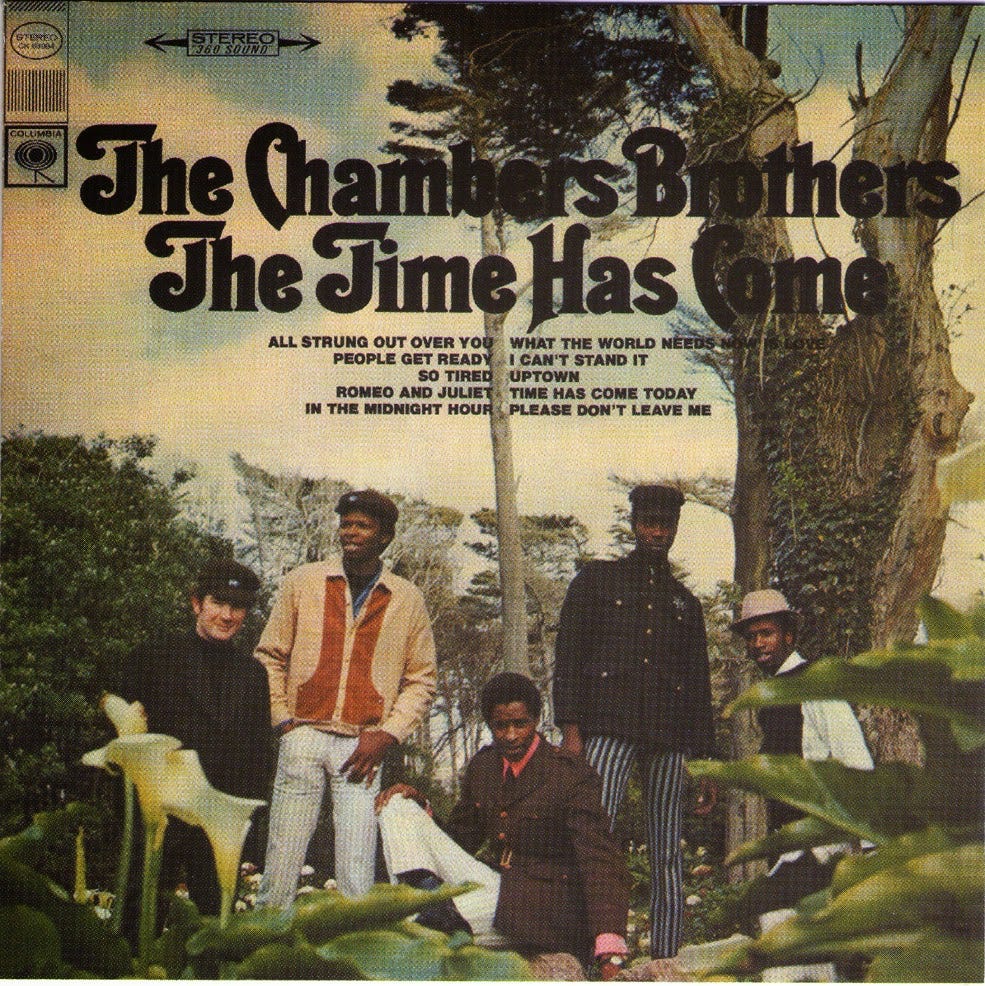
Epic month continues with another late 1960s cut clocking in above ten minutes.
There is enduring power to ‘Time Has Come Today’ by The Chambers Brothers. It rests not just on its musical prowess but also on its cultural impact. Released in 1967 as the final track of their album The Time Has Come, it is one of those songs that, over five decades later, is now seen to encapsulate the zeitgeist of the period steeped in social activism, civil rights movements, and anti-war protests.
The long album version of the song, which runs for about 11 minutes, is very much a sonic experiment, even in time of much sonic experimentation. It features a fusion of soul, acid rock, and psychedelic rock—genres that were rarely stir-fried into a wok at the time. This eclectic blend was a daring move that reportedly concerned the group’s label, Columbia Records. Lester Chambers once recalled being told by the label's president that they should sell the song to a white group on the label, highlighting the genre-bending nature of their music.1
Diving into the song itself, the track opens with a cowbell, a“Cuckoo” and some guitar fuzz. The emotive cry of the title sets a tone of urgency that can be felt in the single version, featured on Nuggets Vol 9 - Acid Rock, where it was sequenced straight after Iron Butterfly’s ‘In-A-Gadda-Da-Vida’.
The song's studio techniques, such as reverb, echo, and tempo changes, showcase a cutting-edge approach to music production. This was a meticulous work, an ambitious painting of the late '60s canvas, made all the more poignant by its reflective lyrics. The technique of sound manipulation may have had its roots in the band's early experiences, as they grew up in the "echo hills of Mississippi," where sounds resonated across the landscape.
‘Time Has Come Today’ wasn't an immediate commercial success. It stalled at #11 on the charts, but its cultural impact far exceeded its initial chart performance. The track found renewed life and wider audiences through the aforementioned Nuggets compilations and frequent inclusions in films and TV shows, an extensive list that spans from the Academy Award-winning film Coming Home (1978) to recent productions fare such as 2021’s Boss Level and 2020’s Da 5 Bloods.
The song's integration goes beyond film. In television, its appearances range from series like CSI: Crime Scene Investigation and Supernatural to becoming the theme tune for the time-travel series Seven Days. Lester Chambers has said that despite the song’s massive impact and enduring appeal, he didn't receive any royalty payments from 1967 to 1994, underscoring the often unfair and sometimes complex nature of the music industry.
Besides its social resonance and media ubiquity, the song also has an underbelly of double entendre. On one level, it can be seen as a rallying cry against the societal ills of the time, particularly the Vietnam War and civil rights injustices. It also incorporates the era’s countercultural flirtation with mind-altering substances like LSD, not so subtly hinted at in the song's lyrics.
The Chambers Brothers' ‘Time Has Come Today’ is a multifaceted artefact representing the political tumult, social change, and musical experimentation of the late 1960s. Its unique blend of soul, rock, and psychedelic elements, daring lyricism, and extensive media appearances all contribute to the song's lasting relevance, making it a staple of American cultural history.
And some questionable, to say the least, views from management.