
An effigy blessed
Talk Talk - 'Runeii' (Laughing Stock, 1991)

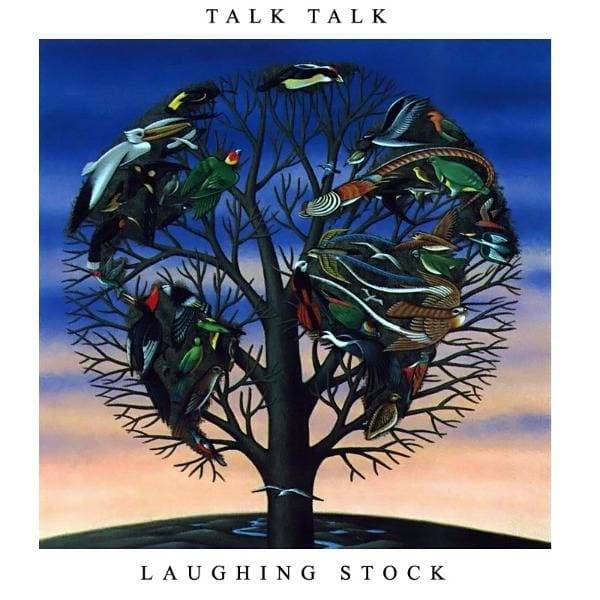
You don’t have to dig too far on the internet to find people talking about the supposed bookends of Talk Talk’s 1991 record, Laughing Stock. Allegedly, both ‘Myrrhman’, the opening track and ‘Runeii’, the closing one, translate literally as “laughing stock.” Unfortunately, this nice symbolism doesn’t seem true. Instead, it seems to be a piece of digital folklore, a fan theory likely born on music forums where the need for poetic symmetry outweighed any linguistic facts. As far as I can see, there is no language, ancient or invented, where these song titles also translate to the album’s title.
However, the reality is still interesting. Rather than a literal translation, the titles are phonetic ghosts of the band’s past. The opener can be seen as a sombre, spiritual pun on ‘Mirror Man’, the band’s synth-pop debut single from 1982 and ‘Renée’ is a track from their 1984 album It’s My Life. Mark Hollis bends those titles towards myrrh (a resin used for embalming) and runic, which implies abstract, ancient languages. So the album invites us to see what remains after so much has been stripped away.
By 1991, Talk Talk had completed one of the most disorienting journeys in popular music. They started in the 1980s as a synth-pop band filed alongside fellow “so good they named it twice” New Romantics Duran Duran in the racks. They performed on Top of the Pops, and their videos showcased flamingos and millipedes on MTV. Mark Hollis had eyeliner and a fringe. Within five years, they had turned inward so completely that their record label, EMI, argued that their fourth album, Spirit of Eden, was not commercially viable1 and nearly forced them to redo their homework. A court case followed as the band sought to escape their contract, and Laughing Stock, recorded for Verve/Polydor after that bitter split and reduced to a duo after bassist Paul Webb left, went further still. It is an album that makes Spirit of Eden sound busy.
The sessions at Wessex Studios in north London lasted from September 1990 to April 1991. Hollis and producer Tim Friese-Greene had the windows blacked out, the clocks removed from the walls, and oil projections thrown onto the ceiling. The only other light source was a strobe. Up to fifty musicians passed through the sessions to improvise on sections without hearing the rest of the track. Most of what they played was discarded. Engineer Phill Brown estimated that eighty per cent of all recorded material was erased. What survived was not assembled into songs in the conventional sense. What emerged was sculpted from fragments, like pottery made from volcanic ash. Hollis frequently maintained that his lyrics were less about narrative and more about phonetics and placement. As he suggested in interviews following the album’s release, phrases were selected for their emotive ‘sound’ and positioned where they felt instinctively correct, often divorced from their original lyrical context.2
Hollis cited Can’s Tago Mago, John Coltrane and Bob Dylan’s New Morning as touchstones. With Coltrane, it was the way his playing occupied space. With Dylan, it was honesty of sound. In the promo material that accompanied the record in 1991, he says:
It just sounds like the band’s in the front room with you.
That domestic intimacy, captured through careful mic placement rather than studio trickery, became the governing principle for Laughing Stock. You can hear the air and negative space around the instruments as clearly as the instruments themselves.
Which brings us to ‘Runeii’. At just under five minutes, it is the shortest track on the album, and the quietest. The song is barely there, gossamer-thin and delicate. Hollis’s voice is a murmur, half-swamped by the reverb on a lone bass guitar. An organ drifts in later, but that’s more like a shaft of sunlight poking through a curtain. The gaps between the notes are seismic, and they are doing as much work as the notes themselves. In the year the album was released, BBC commentator Barry Davies used a memorable line to highlight the value of negative space in the FA Cup semi-final between Tottenham and Arsenal.
Nayim to the left, Samways ahead. And Lineker uses him by not using him – good try, he’s scored!
Hollis viewed silence as a force that sits above everything else. He championed a minimalist hierarchy in which a single note was always preferable to two, and silence was ultimately more valuable than any sound.3
After the eruptions of ‘Ascension Day’, the slow Motorik jam of ‘After the Flood’ and the luminous peak of ‘New Grass’, the album arrives here at something close to exhaustion. Not the exhaustion from excess, the way a typical rock album might burn itself out, the exhaustion of having said precisely enough. There is nowhere quieter to go without actual silence. The song does not build to a climax or resolve. It holds the line, softly turns it over in its hands, and sets it down.
The influence of this record and this approach shouts far louder than the songs on the record do. Artists like Bark Psychosis, Mogwai, Godspeed You! Black Emperor, Sigur Rós and Tortoise all owe something to the space Laughing Stock opened up. Radiohead’s move from The Bends to Kid A is hard to imagine in quite the same way without it. The term “post-rock” was coined partly in response to what Talk Talk and their descendants were doing: breaking rock music down to its raw materials and rebuilding it around texture, dynamics, atmosphere and silence rather than riffs, choruses, and verse structure. But most of those bands eventually chose volume. They built towards crescendos from those quiet moments. Talk Talk, on ‘Runeii’, chose the opposite direction.
After Laughing Stock, Talk Talk quietly disbanded. There was no announcement. Hollis wanted to focus on his family. In 1998, he released a self-titled solo album that pushed even further into stillness, recorded with just two microphones and largely acoustic instruments. It is about as quiet as you can go without being silent. And then he stopped his music career entirely. He gave almost no interviews. He made no public appearances. For the best part of two decades, Mark Hollis was essentially silent. He died in February 2019, and even then, the news arrived quietly, confirmed by his bandmates with little ceremony.
Of all the closing tracks we have looked at over the past five years and across more than 300 entries, this one does not try to revisit the album’s themes. ‘Runeii’ doesn’t send you away with something to remember - it is the antithesis of many of the closing tracks that we have explored and makes no concession to the idea of the peak-end rule, and sends us away with nothing more than the realisation that the record has come to an end.
This is slightly simplified for length. Sources indicate that EMI asked Hollis to re-record or replace material, and that the court case was initiated by the band seeking to terminate the contract rather than by EMI suing over its viability.
Jim Irvin, “Silence Is Polished”, Melody Maker, September 1991. Hollis noted that “the choice of a word is based more on the way it sounds than what it means.” his philosophy is further explored in Phill Brown’s memoir, Are We Still Rolling? (2010).
Mark Hollis interviewed by Richard Skinner, BBC Radio 1, 1991. In this session, Hollis articulated his “silence over sound” manifesto, which became the defining aesthetic of his final years.
“The rest is silence”