But now I guess you've changed your mind
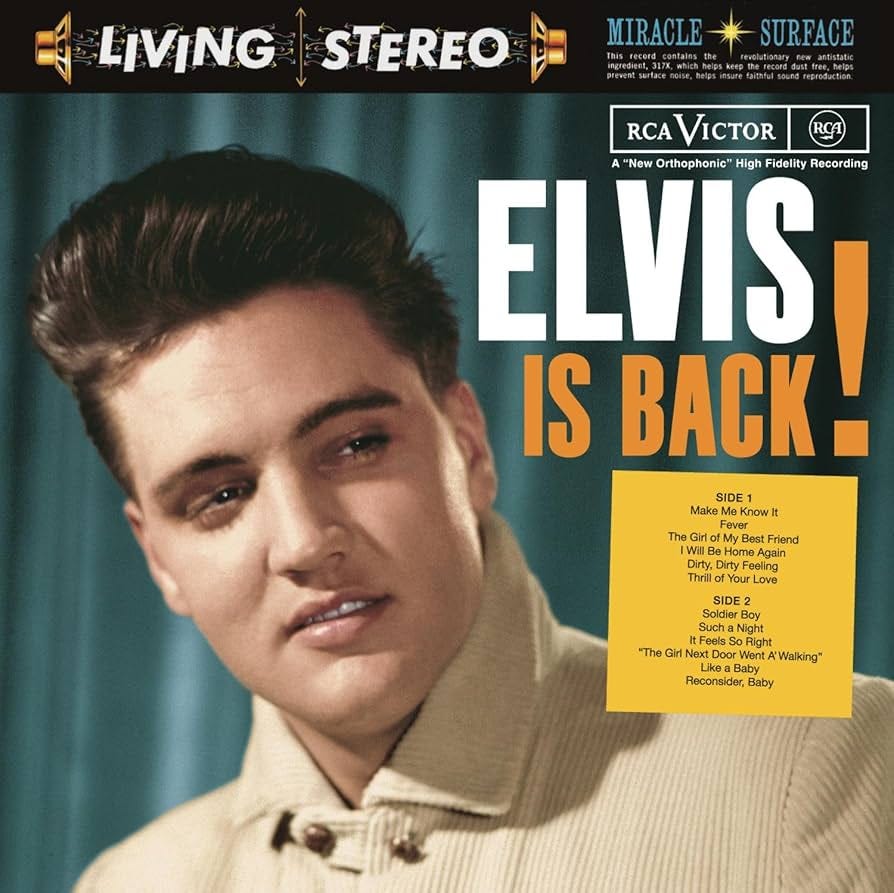
Elvis Presley - 'Reconsider, Baby' (Elvis Is Back! - 1960)
In 1960 Elvis Presley’s career was at a fork in the road. John Lennon would famously say;
Elvis died the day he went into the Army
Assumedly, Lennon meant that the pre-army Elvis had a rebellious edge to his rock and roll that was dulled after two years of service. There’s some truth to that—he wasn’t the same Elvis of the early Sun Records recordings, his explosive debut Elvis Presley, or his iconic, rebellious image in Jailhouse Rock. But his last pre-army recording, the soundtrack to King Creole, although a movie soundtrack, was critically well-received and remains one of his most respected pieces of work. You can, however, draw a line from that to his more formulaic post-army movie work, like G.I. Blues, Blue Hawaii, and Viva Las Vegas. Yet, despite the trajectory of his film career, he would go on to stage a remarkable comeback in the late '60s with his '68 Comeback Special, the Vegas years, and enjoy some notable later career highlights before his untimely death at the age of 42.
Elvis Is Back! was his first foray into the studio in two years—a lifetime in music, especially when artists like Miles Davis had been producing key albums like Milestones (1958) and Kind of Blue (1959), while also experimenting with modal jazz, and Frank Sinatra was recording major works like Come Fly with Me (1958) and Only the Lonely (1958).
We're drinkin', my friend
We are taking a diversion from Acclaimed Music’s Top 100 albums of all time; for newcomers, that site is the source for my entries, and I’ve been counting up from 100. Kanye West’s My Beautiful Dark Twisted Fantasy was #26, so we will resume with Patti Smith
With this context in mind, it’s clear that Elvis’s reign as the top dog of rock ’n’ roll was under threat, particularly with new artists emerging, shifts in musical tastes, and a pop culture that was evolving rapidly.
That makes Elvis Is Back! such an interesting record. Unlike some of his earlier albums, it doesn’t feature massive chart-topping hits—though he recorded iconic tracks like ‘Are You Lonesome Tonight?’ and ‘It's Now or Never’ during the same Nashville sessions, they were left off the record. In a sense, that left Elvis Is Back! with a more eclectic, almost understated collection of songs, giving it an air of artistic exploration. After returning from the army, Elvis had to prove himself as that top dog all over again, and Elvis Is Back! could be seen as his attempt to demonstrate that he was still a serious artist, even though the industry and his management were increasingly pushing him toward more commercial projects (which, eventually, they would win).
Upon its release, this change in direction didn’t sit well with everyone. The New York Times called it drab, but retrospectively, it can be seen as an album ahead of its time—a precursor to the eclecticism seen in later sprawling double and triple albums by The Beatles, The Rolling Stones and The Clash1 that would see them move beyond what was comfortable and expected of them.
The final track, ‘Reconsider, Baby,’ originally written and recorded by bluesman Lowell Fulson in 1954, is a deep, mournful blues song with a slow groove, allowing Elvis to fully immerse himself in a genre that had always been a part of his DNA. While Elvis had dabbled in the blues from the beginning of his career—drawing from the well of black American music in his early rock and roll days—‘Reconsider Baby’ offered a far more authentic blues performance than many of his earlier blues-inspired hits.
Elvis’ rendition of ‘Reconsider Baby’ on Elvis Is Back! was not only faithful to Fulson’s original but also brimming with his own raw vocal intensity. The song’s extended saxophone solo by Boots Randolph brings a smoky, late-night club atmosphere to the recording, while Elvis’ vocals, bluesy and unadorned, create a visceral emotional weight. His voice stretches from soft, intimate moments to growling intensity. The loose, almost live feel of the track gave it a spontaneity that was rare in many of his more polished, commercial hits.
Recorded in Nashville, the song also benefited from the influence of Chet Atkins, who co-produced the session. Atkins’ distinctive production style—often defined by clean, precise guitar work and an attention to the subtleties of tone— offers a neat juxtaposition from the clinical execution of those clipped guitar and bass lines to the more loose and louche piano and sax parts - with Elvis’s vocal bouncing between the two extremes like they are playing pong with it.
Elvis would later continue to explore genres beyond rock ‘n’ roll, delving deeply into country, gospel, and even soul music. This diversity of musical interest that began to shine through on Elvis Is Back! would later manifest fully in that 1968 Comeback Special and his critically acclaimed recordings at American Sound Studio in Memphis, which would produce hits like ‘Suspicious Minds’ and ‘In the Ghetto’.
But Elvis Is Back! remains a key moment in his post-army career, showing an artist at a crossroads—pushing back against the pressures to conform while also trying to re-establish himself as a relevant figure in a music world that had shifted during his absence. It is an album that many critics of today would offer up with his debut and records like From Elvis in Memphis as one of his very best. While some may agree with Lennon that Elvis lost his edge in the army, Elvis Is Back! shows an artist willing to take risks, even if the world wasn’t quite ready to see him as more than just the King of rock ‘n’ roll.
“No Elvis, Beatles, or the Rolling Stones in 1977” The Clash would sing but within a couple of years they were going down a path that all of those acts had trodden.